

Single cell analysis
Cells are the basic unit of the structure and function of organisms. To reveal the chemical nature and laws of life must be on the basis of the research on cells. Due to limitations in sensitivity and sample size, life science research is often mainly based on a large population of cells. However, there are significant microheterogeneities among different individuals of the same kind of cells. The experimental results based on a large population of cells are difficult to reflect the law of life activity at the single cell level. Therefore, single-cell based life science research will be able to reveal the nature and laws of life activities at a deeper level, and to provide a more reliable scientific basis for exploring the causes, development and treatment of major diseases.
Combining immunological recognition with plasmon-enhanced Raman detection, our group has developed plasmonic immunosandwich assay that can quantitatively detect low-abundance proteins (expression level below 1,000 molecules/cell) in a single living cell (Figure 1). In addition, we also substituted immunological recognition with affinity recognition and extend the method to the determination of microRNAs in the nucleus and cytoplasm of individual living cells. Based on the above works, we will apply the above single cell analysis technology to study the apoptotic signaling pathway of single cells, and to establish a method for the determination of key signal pathway proteins and protein complexes at the subcellular level. Such work is expected to provide a scientific and reliable basis for important applications such as accurate efficacy evaluation of anti-cancer drugs and personalized drug screening.
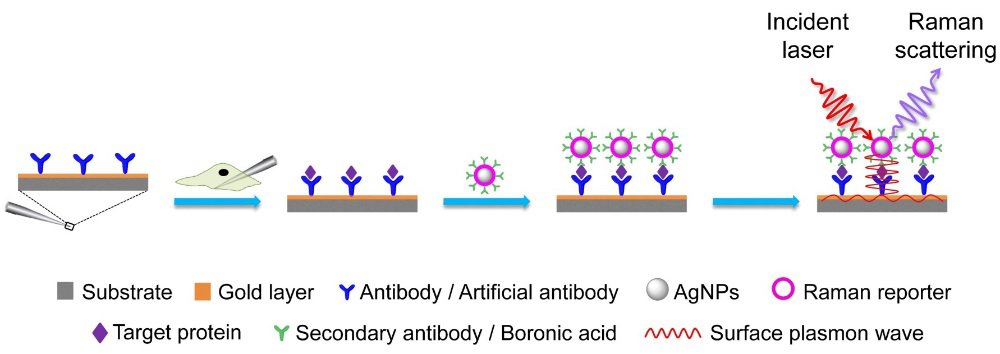
Figure 1. Schematic of the plasmonic immunosandwich assay of low-abundance protein in a single living cell.
163 Xianlin Road, Qixia District, Nanjing, Jiangsu Province
Tel: (86)-25-89685639
Fax: (86)-25-89685639
ZIP: 210023

Copyright © Liu Group