
Self-healing materials and devices
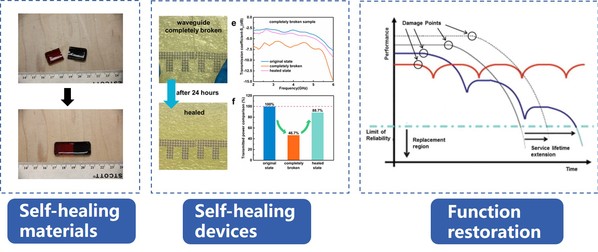
The concept of self-healing technology originates from the phenomenon of self-healing phenomenon in biology. Organisms undergo self-repair processes from the molecular level (such as DNA repair) to the macroscopic level (such as the healing of small skin wounds). Inspired by nature, people have designed and synthesized many self-healing polymer materials that can detect cracks autonomously and repair them through certain mechanisms. Therefore, they can effectively extend the service life of materials, improve material safety, reduce waste, and have important scientific significance and application value. The concept of self-healing has become a research hotspot both domestically and internationally after more than a decade of development since its inception. However, research on self-healing technology still faces significant challenges. For example, current materials are difficult to combine high mechanical strength, high environmental stability, and self-healing properties, which limits their practical applications; The repair of optoelectronic devices requires self-healing materials with various optoelectronic functions, while ensuring that there is no misalignment between the functional layers during the process of repairing the device after it is cut off; Damages of materials or devices often originate not from mechanical damage but from functional degradation, etc. Therefore, we hope to conduct interdisciplinary research and utilize the rich optical, electrical, thermal, magnetic properties and dynamic bonding/breaking processes of complexes to prepare a series of optoelectronic self-healing materials with luminescent, magnetic, conductive, dielectric and other functions; Solving the problem of device interface adhesion and repair through surface interface coordination chemistry; Realize the repair of material or device functions through the study of functional attenuation mechanisms.
南京市栖霞区仙林大道163号 南京大学仙林校区 210023