
Dynamic coordination chemistry
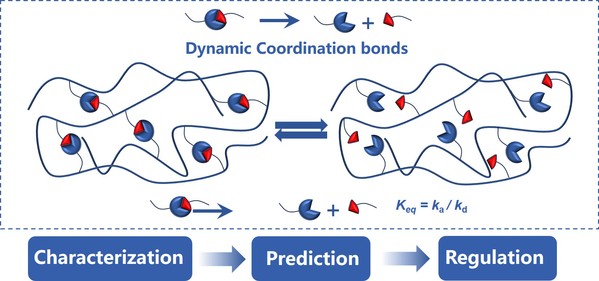
Dynamic coordination chemistry plays a crucial role in many cutting-edge research fields in chemistry. For example, in coordination catalysis, the formation and cleavage of coordination bonds are important steps in catalytic reactions; In interfacial coordination chemistry, the formation and cleavage of bonds between the matrix and the organic functional groups at the interface are determining factors for material's wear, corrosion, oxidation, and other properties; In the development of gadolinium based magnetic resonance imaging contrast agents, controlling the dynamic coordination between water molecules and Gd3+ is an effective method to improve imaging performance. However, our current research on dynamic coordination chemistry is still in the qualitative stage and can only rely on empirical judgment, by constantly changing the metal ions and ligands to find the optimal combination, resulting in relatively low efficiency. Meanwhile, there are still many fundamental questions that need to be answered. For example, how to characterize the dynamics of coordination bonds? How to predict and regulate the dynamics of coordination bonds? How to achieve precise control of dynamic coordination system? Only after clarifying these issues can we further fully leverage the advantages of dynamic coordination bonds, design and synthesize coordination systems with better dynamic performance, and apply them in fields such as chemistry, materials, and biology. Therefore, in future research, we hope to shift dynamic coordination chemistry from qualitative studies to quantitative studies. By developing quantitative testing methods for coordination bonds, establishing a dynamic coordination chemistry database through macro testing, and then useing machine learning to extract models and patterns from the database, we aim to achieve accurate prediction and regulation of dynamic coordination bonds.
南京市栖霞区仙林大道163号 南京大学仙林校区 210023