Recent Research: |
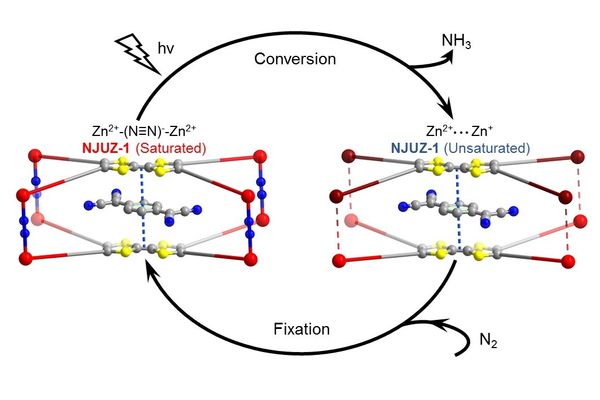
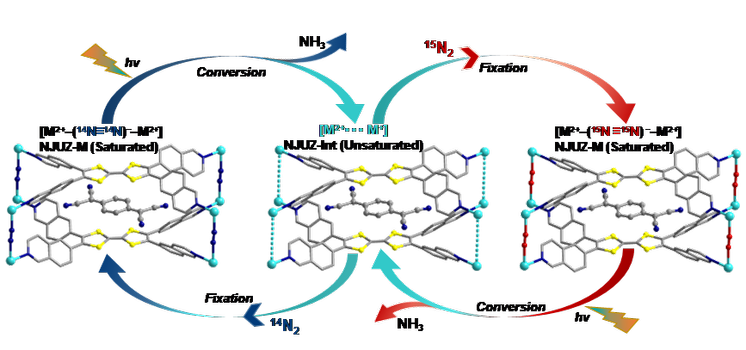
(1) Nitrogen Fixation and Conversion by Dynamic Metal Complexes Nitrogen molecules exhibit extreme chemical inertness, characterized by high stability and resistance to reduction, making nitrogen activation a challenging yet promising research field. We focus on the study of redox-active and dynamic metal complexes with nitrogen-activation sites. Through molecular design and theoretical calculations, a data-driven molecular catalyst model will be constructed. By selectively introducing functional organic ligands and metal ions, the charge transfer properties of organic components will be optimized. Molecular materials with excellent photo/thermal/chemical stability and high light absorption performance will be screened, and their applications for photocatalytic nitrogen fixation and ammonia synthesis will be investigated. For example, our recent findings presented the crystallographic capture of a coordinatively unsaturated dinuclear intermediate in photocatalytic N2 reduction, revealing dynamic interconversion and N2 activation for sustainable ammonia production under ambient conditions.
(2) Multifunctional Molecular Spintronic Materials Magnetic molecular quantum materials are an important research object in spintronics. We try to integrate the two synergistic physical properties of conductivity (or luminescence) and magnetism into the same system to prepare multifunctional magnetic materials such as magnetic semiconductors/conductors, photo- and/or electronically switchable spin crossover materials. Recently, we reported that redox active metal-organic frameworks (MOFs) with ligand spin immobilization demonstrate superior chemispintronic sensitivity and selectivity towards NO,targeting its molecular-radical-like character. It demonstrates a distinct sensing platform for radical-like analytes through strategic design of spin-immobilized molecular functional motifs towards the spintronic device configurations. (3) New Redox Active Coordination Compounds and Their Applications In 1973, scientists discovered that the organic charge transfer salts, TTF-TCNQ has metal conductivity properties. Many research groups have conducted extensive research on organic conductors and superconductors. We have prepared series of new metal complexes by using the p-conjugate ligands with TTF or its derivatives, such as metal bis(dithiolene) units. They show redox activity characteristics, and exhibit strong absorption in the UV visible/near-infrared region, making them potential applications in electrochemistry, optics, and energy storage (such as Li metal and Li–O2 batteries).
Selected Publications: 1. Porous Crystalline Materials Based on Tetrathiafulvalene and Its Analogues: Assembly, Charge Transfer and Applications, Hai-Ying Wang; Jian Su; Jing-Lin Zuo*, Acc. Chem. Res., 2024, 57(13): 1851. 2. Reversible N2 Binding and Photoreduction at Dinuclear Sites in Dynamic Metal-Organic Frameworks, Anqi Zhang; Zedong Zhang; Danyang Xu; Keke Tu; Xiaocheng Zhou; Zixuan Chen; Yan Xiong; Shuai Yuan; Jing-Lin Zuo*, Natl. Sci. Rev., 2026, nwag253. 3. Metal-Coordinated Covalent Organic Frameworks as Advanced Bifunctional Hosts for Both Sulfur Cathodes and Lithium Anodes in Lithium-Sulfur Batteries, Sen Lv; Xingkai Ma; Siwen Ke; Yaoda Wang; Tianrui Ma; Shuai Yuan; Zhong Jin*; Jing-Lin Zuo*, J. Am. Chem. Soc., 2024, 146: 9385. 4. Ligand Spin Immobilization in Metal-Organic Frameworks Enables High-Performance Chemispintronic Detection of Radical Gas Molecules, Cheng Liu; Xiao-Cheng Zhou; Guoao Li; Jian Su; Lingyu Tang; Qinglong Liu; Xiao Han; Sen Lv; Zhangyan Mu; Yamei Sun; Shuai Yuan; Fei Gao; Jing-Lin Zuo*; Shuhua Li*; Mengning Ding*, Sci. Adv., 2025, 11: eadq3554. 5. Photocatalytic Nitrogen Fixation Under Ambient Atmosphere Using a Porous Coordination Polymer with Bridging Dinitrogen Anions, Yan Xiong; Bang Li; Yuming Gu; Tong Yan; Zhigang Ni; Shuhua Li; Jing-Lin Zuo*; Jing Ma*; Zhong Jin*, Nat. Chem., 2023, 15: 286.  |