中文 | Contact Us


News
The Zhen Liu team has made continuous progress in novel coronavirus suppression
Published:2022-06-27
The COVID-19 pandemic caused by severe acute respiratory syndrome coronavirus-2 (SARS-COV-2) has posed a huge threat to human health and social and economic development, and there is an urgent need to develop effective virus control strategies to deal with this unprecedented disaster. Since the outbreak of the COVID-19 pandemic, Professor Zhen Liu had rapidly organized a research team and collaborated with expertised institutions outside the university to explore and develop novel inhibitors of novel coronavirus. Two novel aptamer virus inhibitors have been developed.
According to the characteristics of high mannose expression of glycosylated surface proteins of viruses and cancer cells, the research group first screened out nucleic aptamers that can bind high mannose, and then designed and synthesized polyvalent dendritic aptamers (PAP) and tetrahedral DNA nanostructure (AP-TDN) that can bind high mannose on this basis (Figure 1). These polyvalent nucleic acid agents showed a good ability of targeted recognition of viruses and cancer cells and a certain ability of broad-spectrum inhibition of viruses. As the novel coronavirus rapidly mutates and exhibits strong immune escape ability, broad-spectrum viral inhibitors are of great value. The aptamers that can bind to high mannan laid an important material foundation for the further development of efficient broad-spectrum inhibitors. The work was published as a Research Article in CCS Chemistry, a flagship journal of the Chinese Chemical Society (SSC). Dr. Wei Li, a graduated Ph. D. student of our group, is the first author of this paper, and Professor Zhen Liu is the corresponding author of this paper. Dr. Xilin Wu, associate professor of Nanjing University Medical School, and Dr. Bin Li, professor of Jiangsu Academy of Agricultural Sciences provided technical support.
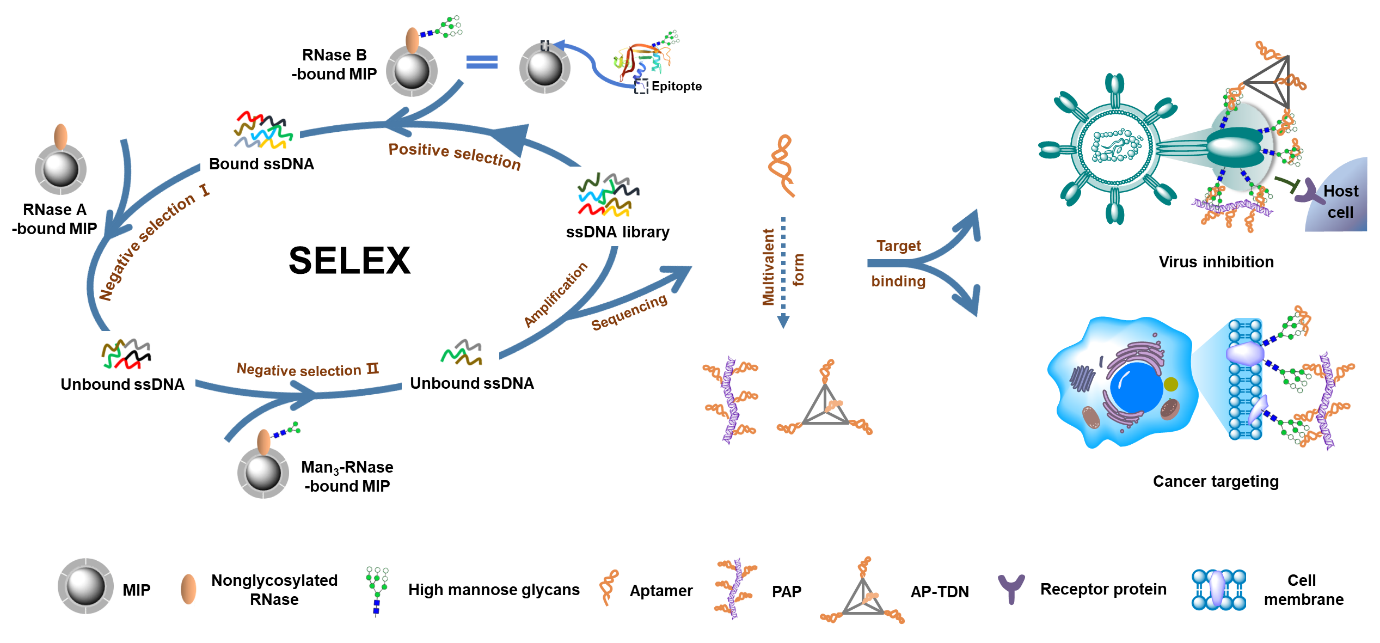
Figure 1. Schematic diagram of the screening, processing and principle of action of high mannose-specific adaptors for virus suppression and cancer cell targets
On the other hand, based on the spike protein (S protein) on the virus surface, which have been widely recognized as the key protein for host cell entry, the research group developed a DNA nanocrown with S protein-topologically matching structure to cope with novel coronavirus strains with sustained mutation. The N-terminal domain (NTD) of S protein is another important epitope in addition to RBD. Antibodies targeting this domain inhibit the membrane fusion process by affecting the "pre-fusion to post-fusion conformational transition" of S protein, thus blocking the virus infection. These effective neutralizing antibodies mostly target a common area of NTD: the NTD supersite. Many therapies combining RBD and NTD neutralizing antibodies are effective against emerging viral variants. Therefore, it is of great significance to develop agents that target the NTD domain. In addition, the structure of NTD domain in S protein on the spatial distribution is relatively fixed, always located in the periphery of S protein trimer, and formed an equilateral triangle of the three vertices. Therefore, by the designed DNA nanostructure, S protein can be locked into the closing status of the most stable conformation and its interactions with the receptor ACE2 can be blocked, which results in fundamental suppression towards the virus infection. First, aptamers targeting NTD supersites were screened and a DNA nanocrown matching the topological structure of S protein trimer was developed. The neutralization ability of polyvalent nanocrown was investigated at the level of pseudo and authentic viruses, and the polyvalent agent showed high inhibitory effect on wild strains and several important mutant strains. The aptamer screening method and the construction of DNA nanocrown can be rapidly extended to newly emerged mutant strains and other lethal virus strains in the future, and can be used as a universal antiviral platform, so it has a broad application prospect. This work was recently published in CCS Chemistry. Jingran Chen, PhD student in our group, is the first author; Dr. Shuxin Xu, a previous research associate of our group, as well as Dr. Qing Ye and Dr. Hang Chi from the Chinese Academy of Military Medical Sciences are the co-first authors. Prof. Zhen Liu is the corresponding author. Prof. Chengfeng Qin at the Academy of Military Medical Sciences, and Prof. Bin Li at Jiangsu Academy of Agricultural Sciences, etc., were co-authors, providing important technical support for this work.
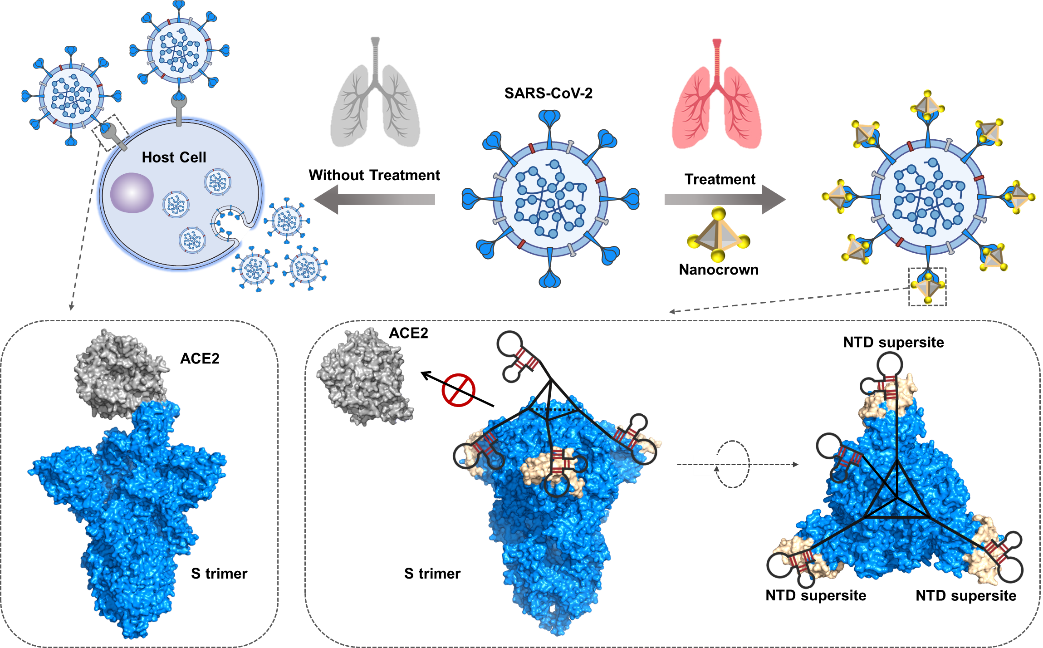
Figure 2. Schematic diagram of SARS-CoV-2 virus suppression by S protein-topologically matching tetrahedral DNA nanocrown
Related information:
Wei Li, Shuxin Xu, Ying Li, Jingran Chen, Yanyan Ma, Zhen Liu. High Mannose-Specific Aptamers for Broad-Spectrum Virus Inhibition and Cancer Targeting. CCS Chemistry, 2022, DOI: 10.31635/ccschem.022.202101747. https://www.chinesechemsoc.org/doi/10.31635/ccschem.022.202101747
Jingran Chen, Shuxin Xu, Qing Ye, Hang Chi, Ying Li, Mei Wu, Baochao Fan, Zhanchen Guo, Cheng-Feng Qin, Bin Li, Zhen Liu. A topology-matching spike protein-capping tetrahedral DNA nanocrown for SARS-CoV-2 neutralization. CCS Chemistry, 2022, DOI: 10.31635/ccschem.022.202201945. https://www.chinesechemsoc.org/doi/10.31635/ccschem.022.202201945
163 Xianlin Road, Qixia District, Nanjing, Jiangsu Province
Tel: (86)-25-89685639
Fax: (86)-25-89685639
ZIP: 210023

Copyright © Liu Group