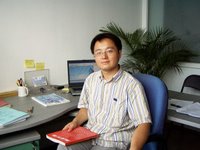
Leyong Wang was born in Shangdong, China. He received a B.S. degree from Changzhou Univ. (1994) and his Ph.D. degree from Nanjing Univ., China in 2000 with Professor Honwen HU, the academicianofChineseAcademyofSciences. After postdoctoral stay at Institute of Chemistry@CAS (2000-2002) with Prof. Youliang Hu, Université de Bourgogne, France with Dr. Jean-Claude Chambron and Prof. Roger Guilard (2002-2003), and Mainz Univ. with Dr. Voker Böhmer (2003-2004), he then became a Humboldt Research Fellow in Erlangen-Nürnberg Univ., Germany affiliated with Professor John A Gladysz. Since 2006, he has been specially appointed as Full Professor of Organic & Materials Chemistry at Nanjing Univ., China. He assumed the position of the vice-Director of Key Lab. of Mesocopic Chemisty, Ministry of Education of China (MOE) in 2016. He was selected as the Fellow of the Royal Society of Chemistry (FRSC) In 2013.
He holds numerous scientific awards, for example, Distinguished Lectureship Award from Chemical Society of Japan(CSJ) (2013), Visiting Lecturership of the Chemistry Promotion Center, Taiwan Area (2016), Achievements and Leadership Award for Excellent Scientific and Technological Contributions, Jiangsu Province (2016), Achievements and Leadership Award for Excellent Scientific and Technological Contributions, Jiangsu Society of Chemistry and Chemical Engineering (2018), and Jiangsu Science and Technology Award (the 1st Class, Oct. 2018).
He has been serving on the editorial board of Supramolecular Chemistry (Since 2014), Chinese J Org. Chem (Since 2019), and on the editorial board of RSC Advacnes as an associate editor (Since 2015). He has been serving on Chinese Chem. Lett. as associate Editor since 2017 and also on Froniters in Chemistry: Supramol. Chem. since 2017. He has served as the co-organizer of several CCS and international conferences in Organic Chemistry and Supramolecular Chemistry. He has authored or coauthored over 160 papers in international peer reviewed journals, book chapters, and patents. His main research area is Supramolecular Chemistry and Biomaterials. The current research covers the phosphine-based macrocycles and cages to topological molecules, as well as new supramolecular dynamic materials for drug develiary and molecular sensing. He currently has an h-index of 39 (Web of Science, on 28 Feb. 2019), 40 ( Google Scholar on 28 Feb. 2019)